
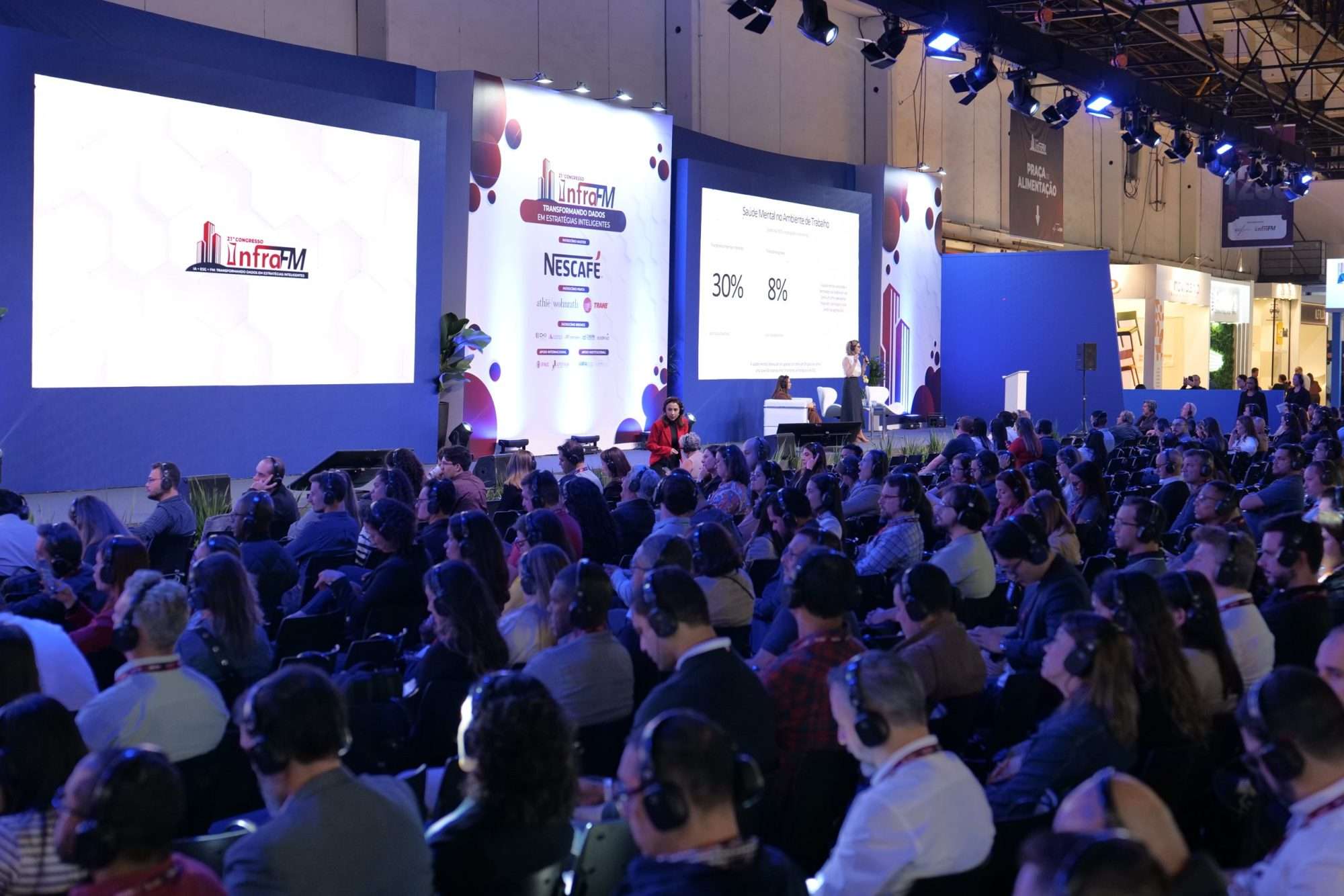
During the opening ceremony of InfraFM, held on Tuesday morning (June 9) at Expo Center Norte, Léa Lobo, creator and Head of Content of the event, and Rimantas Sipas, COO of Italian Exhibition Group Brasil, highlighted the importance of the partnership between their organizations and their shared commitment to driving the development of the Facility Management sector.
Before an audience composed of professionals, exhibitors, and industry leaders, the representatives celebrated another edition of the event, which reaches its 13th Expo and 21st Congress, firmly established as one of the sector’s leading gathering points in Brazil.
“We feel the responsibility of organizing an event of this scale, but it is a positive pressure that drives us to maintain the high standards of the conference program, exhibition, and experiences offered to participants” said Léa Lobo.
Sipas thanked the teams involved in assembling and organizing the event, highlighting the work carried out over the past few days to ensure the venue was delivered on schedule. He also reinforced the three pillars that guide InfraFM’s proposition: knowledge, experience, and business generation.
“We want every participant to find opportunities here to learn, exchange experiences, and develop new business relationships. That is our main goal” he said.
Brazil Strengthens Its Leadership in the Latin American Facility Management Market
The opening panel of the 21st InfraFM Congress brought together experts to discuss the theme “The Global Future of FM and the Role of Latin America, with Brazil as a Leading Player.”
Moderated by Satoshi F. Yadoya, Director of Sodexo’s Facilities Technical Platform, the debate featured Fátima Bottameli, LatAm Director of Facilities Management Solutions at JLL, Alípio Neto, Operations Director at CBRE, and Rodrigo Costev, Director of Facilities Operations at Cushman & Wakefield.
Providing context for the discussion, Yadoya highlighted that the Facility Management market in Latin America generates approximately US $154 billion, of which nearly US$54 billion comes from Brazil.
According to Bottameli, these figures help explain the growing interest of global companies in the region. She noted that Brazil continues to attract significant investments and remains the largest market in Latin America, although it still faces challenges that impact its competitiveness. “The country has received important investments, but it still trails behind locations with fewer barriers, such as Mexico, which has simpler labor legislation” she observed.
Addressing the maturity of the Brazilian market, Neto pointed to the coexistence of two distinct realities. “We have the improvised scenario, which focuses solely on price, and the professionalized scenario, which delivers measurable results supported by performance indicators” he said.
For Neto, expanding the recognition of professional management practices is essential for the sector’s advancement.
Costev reinforced the need for a more strategic approach when making cost-reduction decisions. “Cost reduction must also be evaluated based on the risks it creates. Whenever a company adopts this strategy, it must be prepared to deal with the consequences. Therefore, FM professionals need to take on an increasingly consultative role, assessing risks and contributing to more sustainable business decisions” he emphasized.
At the conclusion of the debate, participants agreed that the growth of Facility Management in Latin America depends on greater professionalization, the adoption of performance indicators, and the strengthening of the strategic role of managers. In this context, Brazil maintains a prominent position as the region’s leading market and one of the most promising for the sector’s expansion.
Case Studies Address Challenges and Solutions for New Work Models
New work models are directly impacting the Facility, Property, and Workplace Management market. This reality became even more evident through two case studies presented during the panel “Liquid Work: How Hybrid Models and the On-Demand Economy Are Redefining the Role of FM,” part of the 21st InfraFM Congress program.
Moderated by Érica Prata, Architect and Co-Founder of AKMX, the session brought together Julita Machado Vezzani, Infrastructure Specialist, and Paula Martins, Senior Manager of Operations and Services at Bradesco Seguros, who shared lessons learned from major workplace transformation projects.
Vezzani detailed the decommissioning process of one of São Paulo’s largest call centers, a facility covering 15,000 square meters and housing more than 2,500 workstations. The entire operation had to be completed within four months. “Right from the start, I realized my team was overwhelmed by such a sudden change and enormous challenge“, she said.
To address the situation, she implemented five management tools that proved essential to the project’s success. “Becoming a more participative leader was the first step, as it brought me closer to the team. We began holding daily alignment meetings, reorganized teams according to soft skills to optimize individual strengths, brought in experts from other units to share knowledge, and invested heavily in quality governance throughout the process.“
As a legacy of the experience, Vezzani highlighted the importance of leadership staying close to operations and sharing the broader business vision with teams, ensuring that work goes beyond execution and includes understanding the purpose behind it.
Martins shared the case of relocating Bradesco Seguros’ headquarters from Alphaville to a historic building on Avenida Paulista, which would also accommodate employees from other branches and centralize operations. “The logistics involved accommodating 2,700 people in just over 2,000 workstations in an organized and structured way” Martins explained.
The challenge required implementing a hybrid workplace model with shared workstations, demanding careful planning and intelligent space management.
Beyond simply organizing occupancy, the entire infrastructure strategy was treated as a direct driver of productivity and engagement. The concept of liquid work, which seeks to balance effort, productivity, and employee experience, guided decisions regarding both layout and operations. “More than investing in desk-booking tools, we implemented monitoring systems to improve occupancy rates and gain predictability as teams grow or new needs arise” Martins said. “In the end, we delivered a workplace where employees genuinely enjoy being, positively impacting their experience and contributing to greater productivity.“
Cebrasse Innovation Forum Highlights Technology and Digital Transformation
Technological innovation and digital transformation were the main themes discussed at the 2026 Cebrasse Innovation Forum, held as part of InfraFM.
The event brings together business leaders, experts, and service-sector professionals to discuss solutions aimed at increasing efficiency, productivity, and competitiveness among Brazilian service companies.
The Forum’s agenda, that took place on June 10 and 11, included lectures and debates on artificial intelligence, process automation, sustainability, and emerging technologies applied to service and facilities management.
Opening the event, João Batista Diniz Júnior, President of Cebrasse, emphasized the strategic importance of technology for business growth. “Investing in innovation is essential to overcoming market challenges and keeping pace with changes in the digital economy.“
Following the opening session, professor and panelist Luiz Marins discussed Brazil’s comparative advantages on the global stage and the growing interest of international investors. “Investors have a very clear understanding of Brazil’s competitive advantages compared to countries such as Indonesia, Turkey, the Philippines, Malaysia, India, Vietnam, Myanmar, and even Mexico and Argentina” Marins stated.
According to him, beyond these advantages, Brazil also plays a critical role in global food security. “We already help feed more than one billion people every day worldwide. Today, we are the largest producers and exporters of coffee, orange juice, beef, sugar and ethanol, soybeans, among other agribusiness products, and we are also the world’s largest producer of poultry, making Brazil the leading supplier of protein to global markets.“
Representing approximately 80 employer organizations across nearly 70 economic sectors, Cebrasse brings together associations, federations, and unions representing more than 878,000 companies and over 12 million formal workers throughout Brazil. According to the organization, the services sector accounts for approximately 72% of Brazil’s GDP and remains the country’s largest generator of employment.
Integrated Corporate Management Platforms Drive Operational Intelligence
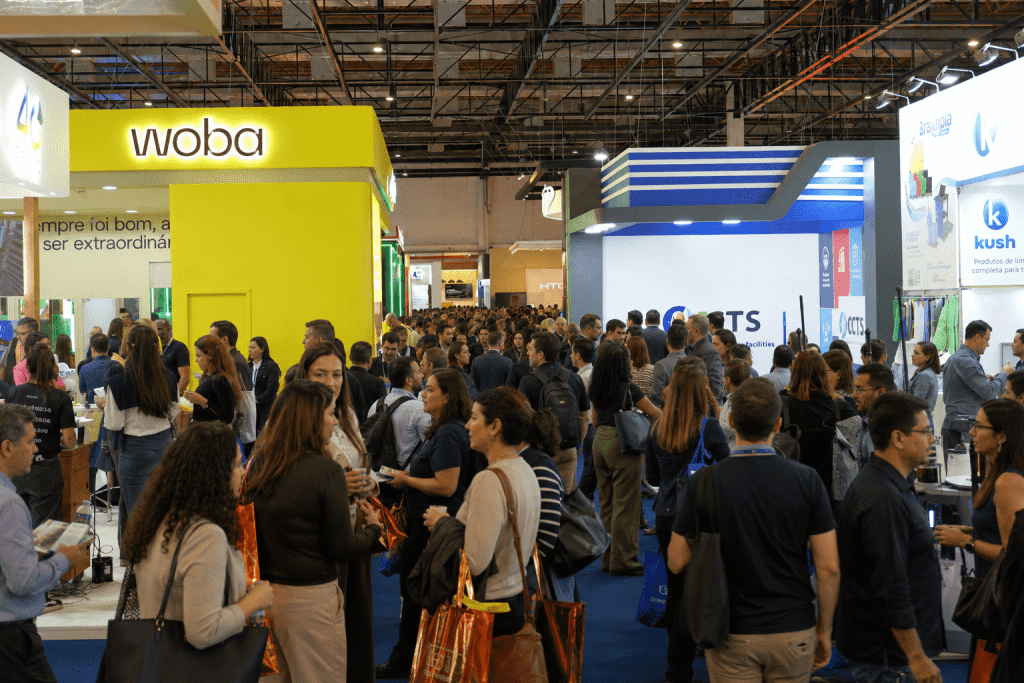
The pursuit of greater operational efficiency, data integration, and business intelligence-driven decision-making has fueled the growth of integrated corporate management platforms, one of the main highlights of Expo InfraFM 2026, which ran through June 11 at Expo Center Norte.
Automatic analysis of operational data, faster and more accurate decision-making, transparency, and efficiency are among the objectives sought by organizations facing increasingly complex challenges related to sustainability, security, and business continuity.
Among the exhibitors, Colorkrew is showcasing its integrated workplace management platform designed to optimize spaces and operations in hybrid work environments.
“Our solutions manage meeting rooms, booths, auditoriums, cafeterias, parking lots, visitor reception, internal service requests, and inventory management, all centralized within a single platform with native integrations to Google, Microsoft, Slack, and Zoom” explained Marcelo Mesquita, Account Manager at the company.
“We are also presenting AI-powered automation resources and real-time monitoring capabilities, reinforcing our proposal to increase operational efficiency, reduce wasted space, and simplify facilities management.“
Meanwhile, WiseOffices is presenting Workplace OS, an integrated platform for intelligent corporate space management.
The solution connects reservations, service requests, occupancy monitoring, attendance tracking, and access control within a single system, transforming facilities operations into a strategic source of data and operational intelligence.
“Sensors monitor real-time occupancy, automatic check-in features streamline usage, and centralized management provides traceability and a unified operational view” said Pedro Abenante, CEO of Wise.
“Our proposal is to replace manual processes and disconnected tools with data-driven management, reducing waste, increasing operational efficiency, and supporting more strategic decisions regarding the use of corporate spaces.“
Companies Showcase Solutions That Optimize Maintenance and Mitigate Risks
AI-based predictive maintenance, rapid spare-parts replacement, and “as-a-service” business models are among the innovations featured at InfraFM, demonstrating advances that improve operational efficiency and mitigate downtime risks.
For businesses where climate control goes far beyond thermal comfort and directly impacts operations, Neshop is betting on speed as a competitive differentiator.
“We focus on customers who cannot afford to wait days for a replacement part needed for critical maintenance” explained Commercial Director Adaílson Teixeira.
“In addition to ready-to-ship inventory, we provide consulting services to help clients build strategic stock tailored to their specific needs.”
Climate control is also the focus of Vulp Air, which is presenting a subscription-based model built around the “as a service” concept.
“In practice, we take over the client’s headache, and they no longer need to worry about air conditioning systems” said Marcelo Rodrigues, Commercial Director.
“Our solutions go beyond traditional maintenance, covering the entire climate-control ecosystem, from equipment rental to preventive and critical maintenance.“
In the maintenance technology field, Fracttal is introducing solutions that integrate CMMS (Computerized Maintenance Management Systems), IoT, and artificial intelligence to increase operational predictability.
“Our integrated AI can not only analyze information but also guide decision-making and create more efficient preventive maintenance plans” explained Nicolas Pereira, Business Manager.
“The practical impact is significant: tasks that previously took days can now be completed in minutes“.